I Want to Live Movie Reviews Lindsay Wagner
| I Desire to Alive! | |
|---|---|
 Theatrical release poster | |
| Directed by | Robert Wise |
| Screenplay by | Nelson Gidding Don Mankiewicz |
| Based on | Articles and messages past Edward Montgomery and Barbara Graham |
| Produced by | Walter Wanger |
| Starring |
|
| Cinematography | Lionel Lindon |
| Edited by | William Hornbeck |
| Music by | Johnny Mandel |
| Production | Figaro, Inc. |
| Distributed by | United Artists |
| Release date |
|
| Running time | 120 minutes |
| Country | United states of america |
| Linguistic communication | English |
| Budget | $1.iv 1000000[1] |
| Box office | $three.5 million[2]—$5.6 million[i] |
I Want to Alive! is a 1958 American biographical motion picture noir directed past Robert Wise, and starring Susan Hayward, Simon Oakland, Virginia Vincent, and Theodore Bikel. It follows the life of Barbara Graham, a prostitute and habitual criminal who is convicted of murder and faces capital punishment. The screenplay, written by Nelson Gidding and Don Mankiewicz, was adapted from personal letters written by Graham, in addition to newspaper articles written by Pulitzer Prize-winning journalist Ed Montgomery. The motion picture presents a highly fictionalized version of the case, indicating the possibility that Graham may have been innocent.
Released in belatedly 1958, I Desire to Live! was a commercial and disquisitional success, garnering favorable reviews from critics for both Hayward's performance equally well every bit the motion-picture show'southward realistic delineation of capital penalization. The film earned a total of six University Award nominations, with Hayward winning a All-time Actress Oscar at the 31st Academy Awards, as well every bit the Golden Earth Honour in the same category.
Plot [edit]
In 1950 San Francisco, petty criminal and prostitute Barbara Graham faces a misdemeanor charge for soliciting sex. She returns to her native San Diego, but is soon charged with perjury after she provides two criminal friends a simulated alibi. She subsequently returns to sexual practice work and other criminal activities to brand a living. She begins working for thief Emmett Perkins by luring men to his gambling parlor. Barbara manages to earn a significant amount of money, and quits working for Emmett to marry Hank, her third husband. The couple have a son, Bobby, only their wedlock is turbulent due to Hank's drug addiction, which leaves him jobless.
Barbara throws Hank out of her business firm, simply is later evicted. Desperate, she leaves Bobby in the care of her female parent and returns to working for Emmett, who is at present associated with thugs John Santo and Bruce Rex. Police force somewhen crack down on the operation, and Barbara surrenders. During the interrogation, all the same, she is stunned when authorities charge her of helping Perkins and Santo murder Mabel Monahan, an elderly Burbank adult female. Barbara insists she was home with her married man and son the night of the murder, simply is indicted by a k jury. Barbara'due south babyhood friend, Peg, visits her in jail, and agrees to help care for Bobby.
Attorney Richard Tibrow is assigned to Barbara's case, and informs her that her alibi is meaningless unless Hank tin can approve it. Barbara foolishly accepts a phony excuse from Ben Miranda, a friend of her jail mate, Rita. Ben insists that Barbara admit she helped with the murder before like-minded to provide the alibi, and she reluctantly implicates herself. During the trial, Hank refutes Barbara's alibi, and a taped recording of her confession, made past Ben during their coming together, is used as evidence confronting her. Barbara insists that she sought the phony excuse but to avert the death sentence, and that her admission is false. She is ultimately convicted, forth with Emmett and John; all three are sentenced to death.
Tibrow withdraws from Barbara's case and is replaced by Al Matthews. In prison, Barbara is relentlessly defiant, refusing to wear her compatible and demanding a radio. Matthews has psychologist Carl Palmberg evaluate Barbara in the hopes of ultimately administering a prevarication detection test. After visiting with her, Carl states that while Barbara appears to be amoral, she is balky to violence; he also points out that she is left-handed, and the bludgeoning death of Mabel was committed by a correct-handed person. Journalist Edward Montgomery, who has covered Barbara'due south example since the beginning, begins questioning her confidence, and starts publishing a sympathetic series profiling her troubled life. As her execution date draws well-nigh, Barbara grows increasingly anxious. A Supreme Court stay gives her hope that her judgement may exist commuted, but it is overturned when Carl dies unexpectedly of centre affliction. Al's petition for a retrial is denied, and Barbara'south execution engagement is set.
The day before her execution, a demoralized Barbara is transferred to San Quentin Prison, where she meets with a priest. That evening, she is angered to hear that her son has been put up for adoption. An anxious Barbara stays up all night, wistfully recounting her marriage with Hank to a prison nurse. For her final repast, she requests an ice cream sundae. In the morn, forty-five minutes before Barbara's scheduled execution, California Governor Goodwin J. Knight declares a stay, but Al's writ is struck down and the execution ordered to proceed. Barbara is taken to the gas sleeping accommodation, but the execution is again halted when Al's amended writ is alleged.
The doubtfulness and agony surrounding her fate reduces Barbara to hysterics. She is returned to her cell, where she and the prison house staff look several minutes for a response to Al'southward writ; they are informed it has once more been rejected, and Barbara's execution is ordered to proceed immediately. Before entering the gas bedroom, Barbara demands a mask, as she does not want to see the faces of the journalists in that location. She is strapped to the chair and executed with cyanide gas. After Barbara is pronounced dead, a despondent Edward leaves the prison. On his style out, he is met by Al, who gives him a note from Barbara thanking him for his efforts to help her.
Bandage [edit]
- Susan Hayward as Barbara Graham
- Simon Oakland as Edward S. "Ed" Montgomery
- Virginia Vincent as Peg
- Theodore Bikel as Carl M.G. Palmberg
- Wesley Lau as Henry L. Graham
- Philip Coolidge as Emmett Perkins
- Lou Krugman every bit John R. "Jack" Santo
- James Philbrook as Bruce King
- Bartlett Robinson as District Chaser Milton
- Marion Marshall as Rita (uncredited)
- Gage Clarke every bit Attorney Richard Grand. Tibrow (credited surname every bit "Clark")
- Joe De Santis equally Al Matthews
- John Marley as Father Devers
- Raymond Bailey as San Quentin Warden
- Gertrude Flynn every bit San Quentin Matron
- Russell Thorson as San Quentin Sergeant
- Dabbs Greer as the San Quentin Captain
- Stafford Repp equally the police Sergeant
- Gavin MacLeod as the police Lieutenant
- Alice Backes as Barbara the San Quentin Nurse
- Wendell Holmes as the police detective
- George Putnam every bit Himself
Accuracy [edit]
According to historian Kathleen Cairns, I Want to Live! "implied that Graham's guilt or innocence was largely irrelevant, that the real criminal offense was committed by a justice organisation that framed her and a media that abetted the endeavor... In reality, the film took liberty with many facts of the case."[3] The picture likewise suggests that Graham, though believed to have sociopathic tendencies in real life, was rather just cocky-destructive due to her loveless childhood and abusive mother.[3]
A prologue and epilogue contributed to the picture show past Edward Montgomery, the journalist who covered Graham'southward case, characterize the movie's content–which largely portrays Graham as innocent of the murder–every bit factual. However, there was substantial testify of Graham's complicity in the crime which included her taped confession to an surreptitious officeholder.[4] Hollywood writer Robert Osborne, who later became the host of Turner Classic Movies, interviewed Hayward and asked whether or not she believed Barbara Graham had been innocent.[5] According to Osborne, the actress seemed hesitant to reply at commencement, but ultimately admitted that her research on the testify and letters in the case led her to believe that the woman she played was guilty.[5]
Despite some of the liberties taken with Graham's story, the film is generally considered to exist very accurate in its depiction of how the California gas chamber functioned in the mid-20th century.[6] [7]
Production [edit]
Development [edit]
The picture show's screenplay was originally written past Don Mankiewicz, based on letters by convicted murderer Barbara Graham, executed in 1955, too every bit a serial of articles by esteemed journalist Edward S. Montgomery.[8] In early 1958, after a typhoon of the screenplay was completed, Nelson Gidding was commissioned to redraft it and tighten the narrative as it "lacked focus" and spent as well much time detailing Graham'south troubled babyhood.[9] Gidding's redrafting also omitted the murder scene of Mable Monohan, as well equally Graham's months spent at San Quentin Prison during her appeals.[ix]
Casting [edit]
Susan Hayward was cast in the pb role of Barbara Graham.[nine] When questioned on taking the controversial role, Hayward said: "I only had to play her. If I hadn't thought they should make [the film], I wouldn't accept played the function."[9]
Filming [edit]
Principal photography of I Want to Live! began in April 1958.[ix]
To ensure the execution sequence was depicted as accurately as possible Wise attended a public execution at San Quentin Prison.[9] Hayward commented after completing filming that her simulated experience of execution led her to believe the do was "medieval."[9]
Musical score [edit]
In addition to Mandel's score, the film features jazz themes performed by Gerry Mulligan's Jazz Philharmonic. Two soundtrack albums were released on the United Artists label in 1958.[ten]
Release [edit]
Box office [edit]
Some sources state the moving picture grossed $three.5 million,[two] though in the Walter Wanger biography Walter Wanger, Hollywood Contained (2000), the picture show is said to take grossed $5,641,711, with a net turn a profit of $2,455,570.[i] Star Hayward was entitled to 37% of the film's overall profit.[xi]
Critical response [edit]
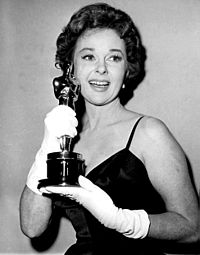
Hayward received an Oscar for her portrayal of Barbara Graham.
Upon release, I Want to Live! was met with a largely favorable critical response, with many critics heralding the film as an "indictment against capital punishment," citing its clinical, harrowing delineation of execution.[12] Producer Walter Wanger received numerous congratulatory letters praising the film after its release, namely from writers Arthur Miller, Paddy Chayefsky, Leon Uris, and Albert Camus, all of whom were agog opponents of majuscule punishment.[13]
Diverseness magazine gave the flick a favorable review: "There is no attempt to gloss the character of Barbara Graham, only an endeavor to understand information technology through some fine irony and pathos. She had no hesitation about indulging in any class of criminal offence or vice that promised excitement on her own, rather mean, terms... Hayward brings off this complex characterization. Simon Oakland, equally Montgomery, who first crucified Barbara Graham in print and then attempted to disengage what he had done, underplays his role with assurance.[xiv]
Film critic Bosley Crowther of The New York Times liked the film and wrote, "...Miss Hayward plays it superbly, under the consistently abrupt direction of Robert Wise, who has shown hither a stunning mastery of the staccato realistic style. From a loose and wise-great B-girl she moves onto levels of common cold disdain and so plunges down to depths of terror and bleak surrender as she reaches the end. Except that the role does not present usa a precisely pretty character, its performance merits for Miss Hayward the nearly respectful adulation."[fifteen]
Factor Blake, the reporter who covered the actual murder trial for the Los Angeles Daily Mirror, and who described how the movie took liberties with the facts, chosen the movie "a dramatic and eloquent piece of propaganda for the abolitionism of the expiry penalty."[16]
By March 1959, Billboard noted that the popularity of the film and of Mandel's and Mulligan's albums "prompted a blitz of jazz film scores", and cited the signing of Duke Ellington to do the score for that year'due south Beefcake of a Murder, the release of The 5 Pennies (a biopic about the jazz band leader Ruby Nichols), and a 1960 documentary Jazz on a Summer'southward Day.[17]
In a 1993 re-appraisal, film critic Danny Peary opines that Hayward is "...the actress of that era [the 1940s and '50s] who most needs rediscovery, and the best film to beginning with is I Desire to Live!."[xviii]
The review aggregator Rotten Tomatoes currently reports a 92% approval rating based on thirteen reviews, with an average rating of 7.9/10.[xix]
Awards and honors [edit]
Habitation media [edit]
MGM Domicile Entertainment released I Want to Live! on DVD for the offset time on May seven, 2002.[24] Kino Lorber reissued the film on DVD featuring a restored impress in October 2015.[25] In November 2016, Twilight Time released the film on Blu-ray for the start fourth dimension in an edition express to 3,000 units.[26]
Accommodation [edit]
I Want to Live! was remade for television in 1983. It featured Lindsay Wagner, Martin Balsam, Pamela Reed, Harry Dean Stanton, Dana Elcar, Ellen Geer, Robert Ginty and Barry Primus.
References [edit]
- ^ a b c d Bernstein 2000, p. 446.
- ^ a b Cairns 2013, p. 123.
- ^ a b Cairns 2013, p. 114.
- ^ Gilmore 2005, pp. 288–291.
- ^ a b Osborne, Robert (February twenty, 2009). I Want to Live! (Telecast of film with commentary). Turner Classic Movies.
- ^ Papke 2012, p. 440.
- ^ Stafford, Jeff. "I Desire to Live". Turner Archetype Movies. Archived from the original on June iii, 2020.
- ^ Cairns 2013, pp. 111–112.
- ^ a b c d due east f g Cairns 2013, p. 112.
- ^ "United Artists UAL-40000/UAL 4000 mono/UAS 5000 stereo Series" (PDF). Both Sides Now Publications. Retrieved August 18, 2015.
- ^ "Susan Hayward". Variety. Nov 12, 1958. p. 5 – via Annal.org.
- ^ Cairns 2013, p. 120.
- ^ Cairns 2013, p. 121.
- ^ "I Want to Alive!". Variety. December 31, 1957. Retrieved March 24, 2008.
- ^ Crowther, Bosley (November 19, 1958). "Bright Performance past Susan Hayward; Actress Stars in I Want to Live". The New York Times . Retrieved March 24, 2008.
- ^ Blake, Gene (November 28, 1958). "Barbara Graham case revisited, November 28, 1958". Los Angeles Daily Mirror . Retrieved July 19, 2018 – via Los Angeles Times.
- ^ Bundy, June (March ix, 1959). "Tardily 50s Bid for Posterity Fame as Real 'Jazz Historic period'". Billboard. p. 42. Retrieved August 11, 2010.
- ^ Peary 1993, p. 146.
- ^ "I Want to Live! (1958)". Rotten Tomatoes. Fandango Media. Retrieved July xix, 2018.
- ^ "The 31st Academy Awards | 1958". Oscars.org. Academy of Motion Film Arts and Sciences. Retrieved August 21, 2011.
- ^ "Official Election" (PDF). AFI's 10 Top ten. American Picture Constitute. Archived from the original (PDF) on July sixteen, 2011. Retrieved August nineteen, 2016.
- ^ "Picture: Foreign Extra in 1960". BAFTA Awards. Archived from the original on June three, 2020.
- ^ "Golden World Awards for 'I Want To Live!'". Hollywood Foreign Press Clan. Archived from the original on June 3, 2020.
- ^ Ordway, Holly E. (May 19, 2002). "I Desire to Live!: DVD Talk Review of the DVD Video". DVD Talk. Archived from the original on June 3, 2020.
- ^ Pewenofkit, Scott (November 12, 2015). "I Want to Alive!: DVD Talk Review of the DVD Video". DVD Talk. Archived from the original on June iii, 2020.
- ^ Harrison, William (Dec 30, 2016). "I Desire to Live! (Express Edition Serial) (Blu-ray)". DVD Talk. Archived from the original on June 3, 2020.
Sources [edit]
- Bernstein, Matthew (2000). Walter Wanger: Hollywood Independent . Minneapolis, Minnesota: Academy of Minnesota Press. ISBN978-0-816-63548-1.
- Cairns, Kathleen (2013). Proof of Guilt: Barbara Graham and the Politics of Executing Women in America. Lincoln, Nebraska: University of Nebraska Printing. ISBN978-0-803-23009-five.
- Gilmore, John (2005). 50.A. Despair: A Landscape of Crimes and Bad Times. Los Angeles, California: Amok Books. ISBN978-ane-878-92316-5.
- Papke, David Ray (2012). Law and Pop Culture: Text, Notes, and Questions. New York Urban center, New York: LexisNexis. ISBN978-0-769-84753-five.
- Peary, Danny (1993). Alternate Oscars: Ane Critic's Defiant Choices for Best Picture, Role player, and Extra — From 1927 to the Nowadays. New York City, New York: Delta. ISBN978-0-385-30332-3.
External links [edit]
- I Want to Alive! at IMDb
- I Want to Live! at AllMovie
- I Want to Alive! at the TCM Movie Database
- I Want to Live! at the American Moving picture Institute Catalog
- I Want to Alive! film trailer on YouTube
Source: https://en.wikipedia.org/wiki/I_Want_to_Live!
0 Response to "I Want to Live Movie Reviews Lindsay Wagner"
Post a Comment